

Protect Our Care Has Tracked Over 1,000 Hospitals and Clinics That Face Cuts or Closure After Republicans Made the Biggest Health Care Cuts in History
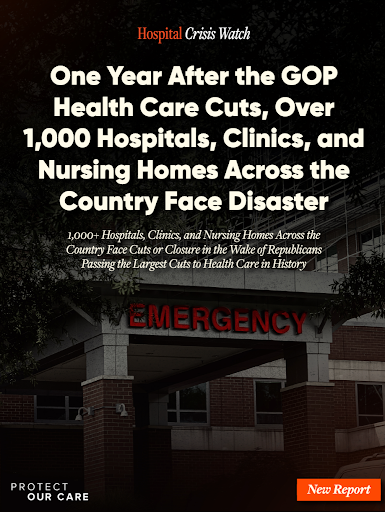
One year ago, Donald Trump and Republicans made the largest health care cuts in history, slashing more than $1 trillion from Medicaid and the Affordable Care Act to fund tax breaks for billionaires and big corporations. Every day since, providers see what happens when health care becomes more expensive and harder to access, and they are warning that the worst consequences are still ahead. Yesterday, Protect Our Care released a new report and interactive website detailing how GOP cuts are pushing hospitals, clinics, and providers to the brink.
Dr. Kristopher Stepps, Traveling Physician in Arkansas and Texas
- “‘Basic necessities are not so basic’ for people in rural areas who are trying to decide whether to pay for extra medication or to travel to their specialist appointments, which Medicaid helps cover.
- “‘There is a fear that if those services are taken away, what happens to the members of this community?’ Stepps said. ‘Regardless if you’re a Democrat [or] Republican, at the end of the day, we’re here to take care of people. My biggest fear is that we start losing more lives due to preventable illnesses because of economic crises and folks couldn’t get access to health care.’” [Capital B]
Dr. Stephanie Augustine, Family Medicine, Colorado
- “She described what happens when someone loses insurance. One patient, a diabetic, was a private business owner and Medicaid enrollee. But he lost Medicaid and couldn’t afford private insurance. ‘He was very proud and very, very, very committed to controlling his health care,’ Augustine said. But he couldn’t afford his medication and his diabetes went unchecked. Without medications and screenings for years, his condition worsened. ‘Uncontrolled diabetes led to disease processes that led to poor wound healing and ultimately led to a loss of limb,’ she said, ‘Not just loss of limb, but also loss of life.’” [CPR News]
Dr. Karen Kinsell, Physician, Georgia
- “Kinsell said she expects conditions for rural hospitals in Georgia to worsen, and to states who chose to expand Medicaid, look no further than southwest Georgia for a glimpse of what Medicaid cuts will do to rural hospitals around the country. ‘People are going to die, they’re going to be scared and injured longer,’” she said. ‘There are going to be a lot more people more permanently disabled because they weren’t able to access health care properly.’” [The Albany Herald]
Dr. Anahita Dua, Vascular Surgeon, New Hampshire
- “‘Ultimately, when these hospitals close, what happens? People have to now travel longer for care. They might not even make it.’”
- “‘This is ultimately not only going to affect the lives of the people that are not going to get the care, but also the majority of the hospitals that provide this care, and the people that are employed by those locations.’” [New Hampshire Bulletin]
Dr. John Andazola, Chief Medical Officer, La Clinica de Familia, New Mexico
- “‘Health care costs will rise due to delayed care, but also access to basic services will diminish if we are forced to reduce programs or worse, cut care and again, close our doors. These cuts will not only threaten the physical health of our patients, it’ll threaten our patients’ financial stability.’” [Source NM]
Dr. Eve Krief, Pediatrician, New York
- “When hospitals close or make cuts, we all suffer, whether we’re on Medicaid or not. They’re not going to be able to provide the services or the care that we all rely on, whatever insurance we have. They’re going to be cutting their psychiatric services, mental health care, and substance abuse services that our families need. Then, they’re going to be cutting staffing, so we’re going to have longer waits in the ERs; we’re not going to have the specialists there. They’ve also had their research funding cuts. So hospitals are really struggling without all kinds of funding sources that they had before, and all our families are suffering.” [Protect Our Care]
Sarah Ortez, Nurse, Tennessee
- “‘Many women in our community cannot afford to drive one or two hours to reach a hospital, and many will not have time to do so once labor begins. These long drive times increase risks for both mothers and babies, leading to more accidental home births or births in cars on the side of the road.’”
- “‘Emergency Medical Services will become even busier, and emergency rooms will become the new delivery rooms, resulting in mother and baby needing transfers to hospitals with appropriate facilities.’” [WATE]
Dr. Chris Ford, Emergency Medicine, Wisconsin
- “When we talk about time and emergency medicine, time is everything. It’s the difference between recovery and disability, between a patient surviving and a patient dying. When a hospital closes, these emergencies don’t stop; the heart attacks don’t stop; the strokes don’t stop. The patients are still there, but they have to travel farther, and they have fewer places to go. That’s the reality of what we’re dealing with. If these cuts continue, patients will continue to pay the price, and not just in dollars, but in delayed care, preventable suffering, and lives lost.” [Protect Our Care]