

The proof is in the pudding: this is a health care election. Americans are paying more for health care, drowning in medical debt, losing their coverage, and watching their local hospitals close their doors. And there’s no mystery about who’s responsible. Last year, Republicans slashed $1 trillion from Medicaid and the Affordable Care Act (ACA) to pay for tax breaks for billionaires and big corporations. Poll after poll shows that health care is top of mind for voters and will impact how they vote this election day. The charts below depict the current state of health care for millions of Americans — employers spending more on health benefits than employees’ wages, health spending and medical debt increasing, coverage loss skyrocketing, and a hospital crisis accelerating by the day.
#1 Health care spending is increasing faster than the overall economy.
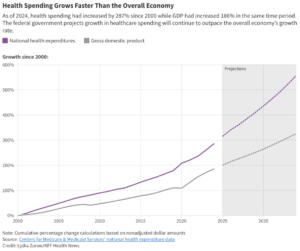 While health care costs have been outpacing economic growth for several decades, the gap is only getting wider. Between 2014 and 2024, national health care spending surged by $2.3 trillion, driven by rising prices and increased demand for care. And with Republicans slashing Medicaid and the ACA, health care costs will continue to skyrocket. Premiums are doubling and even tripling for some Americans, while out-of-pocket costs continue to climb. Next year, health care premiums for ACA plans are projected to rise another 13 percent, while employer sponsored plans will see an increase of 10 percent.
#2 Nearly 8 million people have lost coverage through Medicaid and the ACA since the passage of Republicans’ H.R. 1.
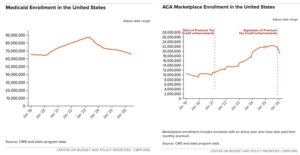
Last summer, Republicans gutted over $1 trillion from Medicaid and the ACA, and Americans have been paying the price ever since. Already, 3.8 million Americans have lost their Medicaid coverage and 4.2 million have lost their coverage through the ACA. Now, between the elimination of premium tax credits, implementation of work reporting requirements, and a mountain of bureaucratic red tape, millions more Americans are at risk of losing their coverage in years to come.
#3 More than 1 in 4 adults have medical debt.
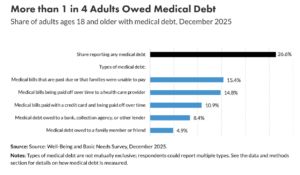 Having health insurance is no longer a guarantee against crushing medical debt. At the end of 2025, more than 1 in 4 adults reported they or a family member had medical debt. And while medical debt is more prevalent among people who are uninsured, a third of adults with private health coverage, through an employer or purchased on their own, also have medical debt. Making matters worse, following the GOP’s cuts to premium tax credits, nearly 2 million more Americans opted for a lower premium, higher deductible insurance plan this year compared to last. Those high deductibles and out-of-pocket costs can still leave patients drowning in medical bills they can’t afford before their insurance even kicks in. Now, health care costs and medical debt rank among the top of financial worries for families across the country.
#4 ACA Marketplace premiums are expected to increase by 13 percent in 2027.
 Americans’ premiums are skyrocketing due to higher health care costs and Republicans’ cuts to premium tax credits. In 2027, premiums for the ACA marketplace are projected to climb another 13 percent, while federal worker and employer sponsored coverage could see increases of around 10 percent. Between 2025 and 2027, the average monthly premium for a silver plan has already jumped 42 percent. And as coverage becomes increasingly unaffordable, millions more Americans are expected to be priced out of the market place altogether. The Congressional Budget Office estimates that ACA enrollment will plummet by 9.3 million, from 22.4 million in 2025 to 13.1 million in 2027.
#5 Over 1,250 hospitals, wards, clinics, and other health care providers are at risk for or have made cuts, announced closure, or have already closed.
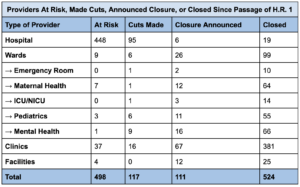 The hospital crisis is growing, and communities across the country are being forced to travel further for life saving care. Following Republicans’ $1 trillion in health care cuts, more than 1,250 hospitals, clinics, and nursing homes have shut down, cut services, or are at risk of doing so. Rural communities are especially vulnerable, with 12 percent of rural Americans already living more than an hour away from the nearest hospital in times of life or death emergencies. And as more and more hospitals close, surrounding providers are seeing increases in patient volume resulting in longer wait times and worse health outcomes. This crisis is particularly alarming for expectant mothers, with 1 in 3 counties lacking a birthing facility or obstetric clinician. The United States has the highest maternal mortality rate of any high income nation, yet Republicans have chosen to ignore this crisis and cut Medicaid, the very program that finances roughly 40 percent of births nationwide.
#6 Employers are spending more on health benefits than wages or salaries.
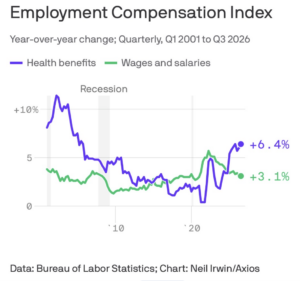
Health care costs are rising twice as fast as wages, and American workers are paying the price. According to the Bureau of Labor Statistics’ quarterly Employment Compensation Index, employer health benefit costs have jumped 6.4 percent over the past year, while wages and salaries have increased by just 3.1 percent. Even with unemployment and layoffs remaining low, Americans are still experiencing deep economic dissatisfaction largely due to health care benefits eating away at their take-home pay.